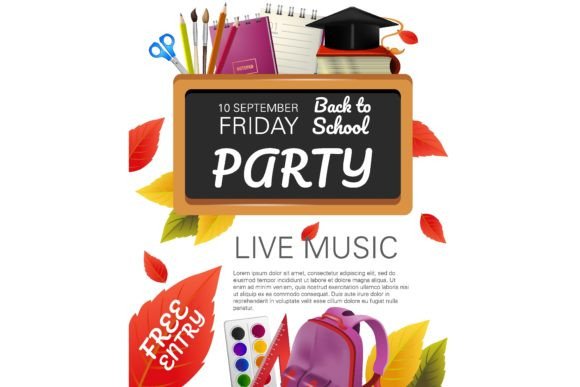
Free Entry, Back to School Party Flyer D: A Practical Design Resource for Educators and Organizers
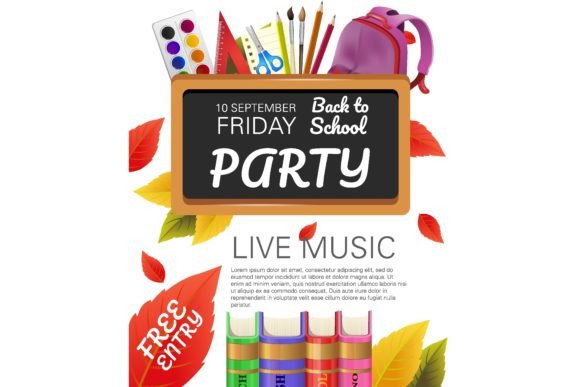
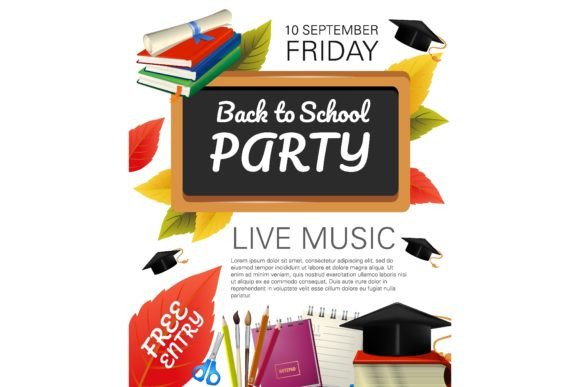
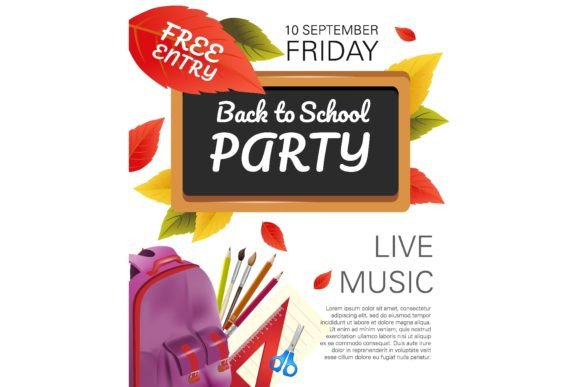
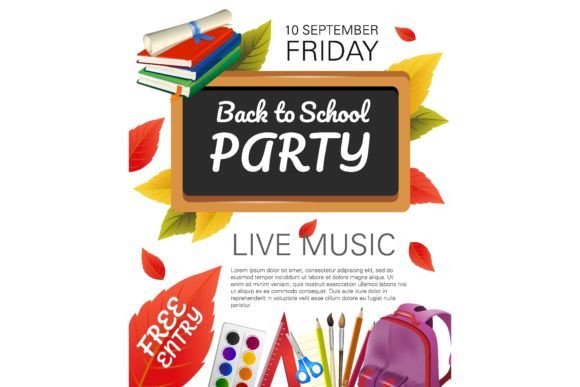
Free Entry, Back to School Party Flyer D is a ready-to-use printable and digital design template intended for school-related community events—particularly back-to-school celebrations that emphasize accessibility and inclusivity. Its defining visual elements include a graduation cap, stacked textbooks, subtle fall foliage accents (like maple leaves or warm-toned branches), and stylized school supplies such as pencils, notebooks, and rulers. Unlike generic templates, it integrates these motifs cohesively while maintaining clear visual hierarchy and space for essential event details. The “Free Entry” designation isn’t just a headline—it’s a functional cue embedded in the layout, typically placed near the top in bold, legible typography to signal no admission fee or registration barrier.
How It Stands Out Among Back-to-School Visual Resources
Many back-to-school flyer designs lean heavily into either youthful exuberance (bright cartoon characters, exaggerated fonts) or formal institutional tone (school logos, muted palettes, rigid grids). Free Entry, Back to School Party Flyer D occupies a middle ground: professional enough for PTA meetings or district-sponsored events, yet warm and inviting for families with children across grade levels. The inclusion of fall foliage adds seasonal relevance without locking the design into a narrow timeframe—unlike templates featuring pumpkins or snowflakes, which feel out of place before mid-September or after early October. Similarly, the graduation cap signals academic aspiration without implying the event is exclusively for seniors; it’s used here as a symbolic anchor, not a literal indicator of audience.
The books and school supplies are rendered in clean line art or soft flat illustration—not photorealistic, not overly playful—which supports readability at multiple sizes. That matters when the same file might be printed as an 8.5" × 11" handout, scaled to a 24" × 36" banner, or cropped for social media previews. This versatility reflects intentional design thinking, not just aesthetic preference.
Practical Use Cases and Real-World Fit
Free Entry, Back to School Party Flyer D works especially well when organizers need to communicate three things quickly: that the event is open to all, that it celebrates learning transitions, and that it’s grounded in local community values. For example, a neighborhood library hosting a “Meet Your Librarian + Supply Swap” event can use this flyer with minimal text edits—replacing placeholder dates and adding a short line about gently used notebook donations. A middle school PTA using it for a family orientation picnic benefits from the graduation cap’s aspirational tone and the foliage’s connection to the school year’s natural rhythm.
It’s less suited for highly branded campaigns requiring strict adherence to institutional color palettes or logo placement rules—there’s no built-in logo box or custom hex code field. Nor does it accommodate multilingual announcements out of the box; the layout assumes English-first copy with standard left-to-right flow. If your audience includes significant Spanish-, Vietnamese-, or Arabic-speaking families, you’ll likely need to adjust spacing and line breaks manually—a manageable task, but one that adds time to preparation.
Comparing Format Options: Print, Digital, and Hybrid Needs
Free Entry, Back to School Party Flyer D is typically distributed as a downloadable PDF or editable PSD/AI file. That format choice carries real implications. A PDF version preserves fidelity across devices and printers but limits customization—you can add text, but changing colors or rearranging elements requires external tools. An editable vector file (like AI or EPS) gives full control over layers, typography, and color—but demands basic familiarity with design software. Users comfortable with Canva or Google Slides may find the PDF version more immediately usable, even if it means working within fixed margins.
Compare this to web-based flyer builders, where drag-and-drop interfaces simplify updates but often sacrifice typographic nuance or print-ready resolution. Free Entry, Back to School Party Flyer D doesn’t compete with those platforms—it complements them. You might draft messaging in Canva, then refine final layout and color balance using the downloadable file. Or print 50 copies for bulletin boards and export a cropped version for Instagram Stories, keeping visual continuity across touchpoints.
Strengths, Tradeoffs, and Decision Factors
Strengths:
- Clear visual signaling of “free entry” without relying solely on text—iconography and layout reinforce the message
- Balanced seasonal cues that extend usability across late summer and early fall
- Ample white space for contact info, dates, and logistical notes—even when printed small
- No licensing restrictions for non-commercial educational use (always verify source terms)
Tradeoffs:
- Limited adaptability for schools with strong visual identities (e.g., specific mascot integration or district-approved fonts)
- Foliage and cap illustrations may read as “traditional” rather than inclusive of diverse learning pathways (e.g., vocational programs, homeschool collectives, adult education)
- Not optimized for accessibility by default—contrast ratios, alt-text readiness, and screen reader compatibility depend on how users modify the file
When deciding whether Free Entry, Back to School Party Flyer D fits your needs, consider your timeline, technical comfort, and audience expectations. If you’re preparing materials two weeks before an event and need something reliable, legible, and broadly resonant, it’s a pragmatic starting point. If your school prioritizes culturally responsive imagery—or if your event targets teens and adults rather than elementary families—the symbolism may require thoughtful adaptation.
When to Choose It—and When to Look Elsewhere
Choose Free Entry, Back to School Party Flyer D if your priority is clarity over novelty, consistency over customization, and speed over stylistic distinction. It serves best when the goal is functional communication—not brand elevation or artistic expression. Think of it like a well-cut blazer: not flashy, but dependable across contexts.
Look elsewhere if your event centers around a specific theme (e.g., STEM night, bilingual welcome fair, or special education resource fair), where iconography and language need tighter alignment. Also reconsider if your team lacks access to editing tools or relies entirely on volunteers with no design experience—some versions assume basic familiarity with layer visibility or text box resizing. In those cases, a simpler, single-page Canva template with fewer movable elements may reduce friction more effectively.
Importantly, “free entry” in the title shouldn’t be mistaken for “free effort.” Even streamlined resources require thoughtful implementation: verifying date accuracy, confirming venue accessibility notes, and ensuring contact information is current. The flyer supports the message—it doesn’t replace careful planning.
Final Considerations for Informed Selection
Evaluating Free Entry, Back to School Party Flyer D alongside alternatives isn’t about finding the “best” design—it’s about matching form to function. Ask yourself: What’s the primary action you want readers to take? (RSVP? Bring supplies? Just show up?) How much time do you realistically have to revise and proof? Who will handle printing—and what constraints do they face? A flyer that looks perfect on screen may lose legibility when photocopied on recycled paper.
Also consider longevity. If you plan to reuse the design annually, assess whether the fall foliage and cap motifs still resonate five years from now—or whether a more neutral background (e.g., abstract geometric patterns or subtle watercolor washes) would offer greater flexibility. Free Entry, Back to School Party Flyer D excels in its moment: welcoming students, families, and staff back with warmth, clarity, and quiet intention. Used deliberately, it supports that goal without overshadowing it.