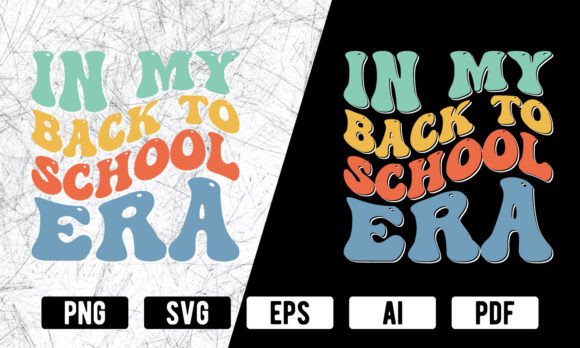
In My Back to School Era
“In My Back to School Era” isn’t just a nostalgic phrase—it’s a strategic lens for intentional renewal. For adults navigating complex professional seasons—whether launching a Print on Demand store, designing custom apparel bundles, or refreshing a personal brand—it signals a deliberate pivot toward growth, learning, and recalibration. Unlike passive nostalgia, this era is grounded in action: revisiting foundational skills, refining systems, aligning offerings with audience needs, and building assets that compound over time. It reflects a mindset where every design decision, product launch, or content strategy begins with clarity—not trend-chasing.
Why This Era Matters Now
Market saturation in digital apparel design means differentiation hinges less on novelty and more on resonance. SVG files labeled “Retro Wavy SVG,” “Groovy Wavy T-shirt,” or “Typography SVG” flood marketplaces—but buyers increasingly seek authenticity, versatility, and narrative cohesion. That’s where In My Back to School Era becomes operational. It’s the quiet commitment to understand *why* wavy lines evoke warmth and movement, *how* vintage typography builds trust in a crowded feed, and *when* a 300dpi PNG sublimation file serves a client’s production workflow better than an SVG alone.
This era supports long-term positioning by anchoring creative output in purpose. A “Wavy Lover SVG” isn’t just aesthetic—it’s a signal to a specific audience: people who value tactile texture, analog warmth, and expressive minimalism. When you approach each design as part of a curated era—not a one-off upload—you build recognition, repeat engagement, and scalable asset libraries (like SVG design bundles that include EPS, AI, PDF, and JPEG variants).
Strategic Use Cases Across Roles
Different professionals leverage In My Back to School Era in distinct but aligned ways:
- Entrepreneurs and POD sellers use it to audit inventory depth—not just quantity, but functional range. A “Groovy Shirt” collection gains strength when paired with matching mug-ready PNGs (4500×5400 at 300dpi), vinyl-cutting-optimized SVGs, and layered AI files for client customization. Each format serves a real-world use case—not just platform requirements.
- Educators and trainers apply it to curriculum design: teaching vector fundamentals through retro wavy layouts helps learners grasp path manipulation, kerning, and responsive scaling in context—not abstraction. The “Wavy Line Shirt” becomes a teaching artifact, not just merch.
- Freelancers and designers treat it as a boundary-setting tool. Instead of accepting vague briefs like “make it groovy,” they anchor proposals in era-aligned outcomes: “We’ll develop a cohesive Retro Groovy Shirt system—including primary SVG t-shirt art, alternate colorways in PDF, and sublimation-ready PNGs—so your team can deploy across print, web, and social without rework.”
- Small business owners use it to unify customer experience. A café launching branded apparel doesn’t just slap a logo on a tee. They ask: What does “In My Back to School Era” mean for *our* community? Is it about curiosity? Unhurried learning? Shared nostalgia? That answer informs whether “SVG Wavy Design” leans into chalkboard textures, muted palettes, or hand-drawn imperfections—and ensures every shirt feels like a natural extension of the brand voice.
Planning With Intention—Not Just Aesthetics
A “Trendy wavy SVG t-shirt” only delivers ROI when its creation follows deliberate planning. Start with outcome mapping: Who uses this file? How? Where? Does a scrapbooker need layered SVGs with grouped elements? Does a screen printer require outlined fonts and CMYK-ready PDFs? Does an educator need editable text in the AI file?
Consider this practical sequence:
- Define the core function: Is this primarily for cut machines (requiring clean paths and no overlapping strokes), sublimation (needing high-res raster + bleed margins), or digital display (where SVG’s scalability shines)?
- Select formats strategically: Don’t default to “all files included.” If your audience is predominantly Cricut users, prioritize SVG and DXF. If they’re Etsy resellers sourcing for mugs and tumblers, emphasize PNG and PDF with precise dimensions and safe zones.
- Build modularity: Design “Retro Wavy SVG” elements as reusable components—waves, borders, quote frames—so clients (or your future self) can mix, match, and rebrand without starting from scratch.
- Document usage context: A quick-view guide with your bundle (“Best for: vinyl decals, cotton tees, sticker sheets”) reduces support queries and increases perceived value.
Risks of Using the Era Without Clarity
Without grounding in goals, “In My Back to School Era” risks becoming decorative rather than directional. Common pitfalls include:
- Format bloat: Including EPS, AI, PDF, SVG, PNG, and JPEG without verifying which ones your audience actually uses. Each added file increases storage, slows uploads, and dilutes focus—if your buyers are exclusively using Cricut Design Space, AI and EPS add zero utility.
- Aesthetic drift: Applying “groovy” or “retro wavy” treatments indiscriminately—say, forcing a wavy baseline onto technical documentation or legal disclaimers—undermines credibility and confuses messaging.
- Asset fragmentation: Releasing “Wavy T-Shirt” designs as isolated files instead of part of a coordinated system (e.g., no consistent spacing rules, inconsistent stroke weights, or mismatched color palettes across SVG and PNG versions) makes future scaling harder, not easier.
These aren’t failures of taste—they’re symptoms of unclear intent. The era only delivers leverage when tied to a specific outcome: faster client onboarding, broader production compatibility, stronger visual consistency, or deeper audience alignment.
Long-Term Value Beyond the First Sale
The most durable value of In My Back to School Era lies in compounding asset utility. A well-structured “SVG Wavy Design” bundle isn’t consumed and discarded—it becomes infrastructure. Designers reuse wave motifs across seasons. Educators adapt quote-based SVGs for classroom posters, newsletters, and student handouts. Entrepreneurs layer retro wavy elements into email headers, packaging inserts, and social banners—extending reach without new creative lift.
That durability requires upfront discipline: naming conventions that clarify use (e.g., “InMyBackToSchoolEra_WaveBorder_SVG_CutReady”), embedding metadata in AI/EPS files, and maintaining version control across formats. It also means resisting the urge to over-design. A “Text SVG” with clean, legible letterforms and generous line spacing will outperform a visually dense “Groovy Wavy bundle T-shirt” in contexts demanding readability—like event signage or accessibility-conscious platforms.
Ultimately, In My Back to School Era endures not because it looks good, but because it works reliably across tools, teams, and timelines. It’s the difference between shipping a file and shipping a solution.
Moving Forward With Purpose
You don’t need to relaunch your entire catalog to enter this era. Start small: pick one existing “Retro Groovy Shirt” design. Audit its file suite against real user needs. Replace one redundant format with documentation. Add a single scalable element—a wavy divider, a quote frame—that can be reused elsewhere. Measure what changes: fewer support questions? Faster client revisions? Higher bundle upsell rates?
That’s how In My Back to School Era shifts from slogan to strategy. It’s not about returning to school—it’s about choosing to learn, refine, and build with greater awareness of how each decision serves your people, your process, and your long-term capacity. The wavy line isn’t just decoration. It’s a reminder that progress rarely moves in straight lines—and that the most resilient designs, brands, and careers are built with intention, iteration, and quiet confidence.