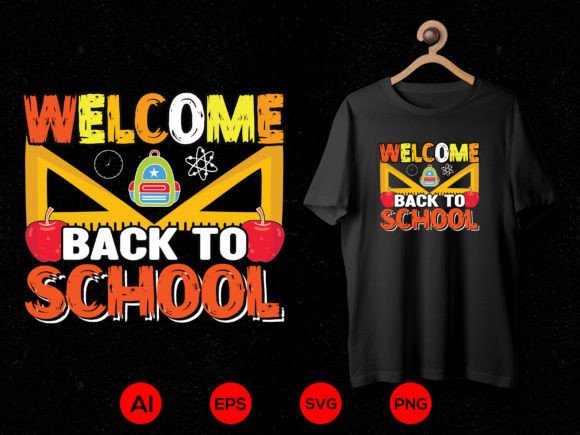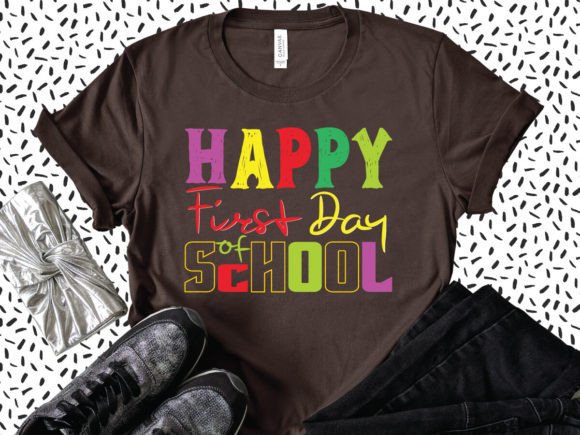
Back to School T Shirt Design-15: A Practical Evaluation for Educators, Parents, and DIY Creators
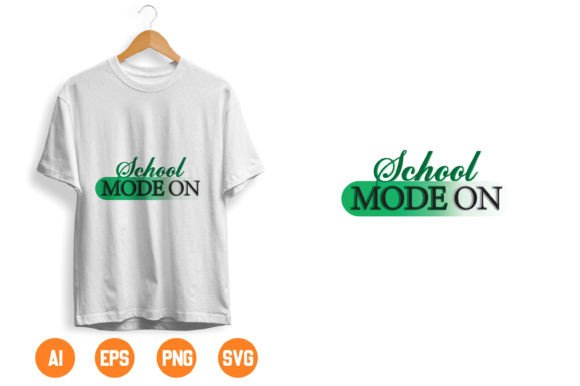
Back to School T Shirt Design-15 is a ready-to-use digital design asset centered around the phrase “School MODE ON” — a lighthearted, modern take on the transition from summer break to academic routine. Unlike generic school-themed graphics, this design combines clean typography with subtle visual rhythm, making it adaptable across apparel and lifestyle products. It’s not just a slogan; it’s a flexible visual element built for real-world application — from classroom staff shirts to student welcome kits or PTA event merchandise.
What Sets Back to School T Shirt Design-15 Apart?
Three structural features distinguish this design from many off-the-shelf back-to-school assets:
- True vector scalability: Delivered in AI, EPS, and SVG formats, every element remains crisp at any size — whether printed on a toddler’s onesie or scaled to cover a 36-inch hoodie chest print.
- Color flexibility by design: Layered vector paths allow quick hue swaps in vector editors (Illustrator, Affinity Designer, Inkscape) without raster distortion or manual redrawing — a practical advantage over flattened PNGs or JPEGs with embedded color.
- Multi-surface readiness: The inclusion of high-resolution PNG and JPEG files — alongside vector formats and a mockup — supports both digital previews and physical production workflows, including heat-transfer vinyl cutting, DTG printing, and sublimation.
This isn’t a single-purpose graphic. Its construction reflects an understanding of how end users actually work: educators ordering bulk shirts through local screen printers, crafters using Cricut or Silhouette machines, or small businesses building seasonal collections.
How It Compares With Other Back-to-School Design Options
Most back-to-school digital assets fall into one of three categories: text-only layouts, illustrated scenes (e.g., apples, buses, chalkboards), or layered photo composites. Back to School T Shirt Design-15 sits deliberately between minimalism and personality — avoiding clichés while retaining immediate readability.
Compared to text-dominant designs, it offers more visual balance: the “MODE ON” treatment uses spacing, weight contrast, and subtle alignment cues that guide the eye without relying on icons. Against illustration-heavy alternatives, it avoids age-specific assumptions — no cartoon characters or grade-level references — making it equally suitable for middle school faculty, college orientation teams, or homeschool co-ops.
Where some designs prioritize decorative flair (ornate borders, watercolor textures), Back to School T Shirt Design-15 prioritizes function: clean edges for cut-file accuracy, consistent stroke weights for embroidery digitizing, and uncluttered negative space that accommodates fabric texture and garment drape.
Practical Use Cases and Realistic Limitations
This design excels where clarity, consistency, and production efficiency matter. For example:
- A PTA committee ordering 80 cotton tees can use the SVG file to adjust colors to match their school’s palette, then export a print-ready PDF for their vendor — all in under 15 minutes.
- A maker using a Cricut Maker can import the SVG directly, assign cut settings per layer, and produce iron-on transfers for backpacks, tote bags, and pillowcases — no tracing or re-vectoring needed.
- An art teacher creating classroom décor might combine the PNG version with student-drawn elements in Canva or Google Slides, using the transparent background to overlay onto bulletin board templates.
However, it’s not universally optimal. If your goal is photorealistic apparel mockups for e-commerce listings, the included mockup may require customization — it shows one standard shirt style and doesn’t offer variant angles or fabric swatches. Similarly, while the design scales infinitely, its current layout assumes horizontal orientation; rotating it vertically or wrapping it around curved surfaces (like mugs) would need manual adjustment in design software.
It also assumes baseline familiarity with vector editing tools. Someone using only free mobile apps (e.g., PicsArt or Snapseed) will find the PNG and JPEG versions usable but lose the ability to recolor or resize without quality loss. That’s not a flaw — it’s a boundary of scope aligned with its intended audience.
When Back to School T Shirt Design-15 Is the Right Fit
This design is especially well-suited when you need:
- Speed without compromise: You’re finalizing orders two weeks before term starts and need a professional-looking result without custom design fees or multi-round revisions.
- Consistency across items: You’re producing matching shirts, hoodies, and stickers for a school-wide initiative and want identical rendering across materials — vector formats ensure that.
- Control over execution: You’re working with multiple vendors (a local screen printer for tees, a sublimation specialist for mugs, a vinyl cutter for decals) and prefer managing one source file rather than coordinating separate adaptations.
- Room for personalization: You plan to add names, grades, or dates — the open composition leaves ample margin for supplemental text without crowding.
When You Might Consider Alternatives
Back to School T Shirt Design-15 may be less ideal if:
- You require fully editable text within the file itself (e.g., changing “MODE ON” to “CLASS IN SESSION”) — the current version treats the phrase as grouped vector shapes, not live type. While editable in Illustrator, it’s not plug-and-play in Canva or basic word processors.
- Your project demands stylistic cohesion with existing branding — say, a hand-drawn aesthetic or specific font licensing. This design uses clean, neutral sans-serif forms; it won’t mimic brush-script or retro display fonts without significant modification.
- You’re producing for very young children and need simplified, high-contrast visuals — the current layout relies on typographic nuance rather than bold iconography, which may reduce immediate recognition for pre-readers.
- You need integrated multilingual support — the design contains English text only, with no built-in alternate language layers or layout variants for right-to-left scripts.
Evaluating Value Beyond the File List
The listing promises six formats (AI, EPS, SVG, PNG, JPEG, mockup) and highlights “100 print ready” and “100 vector shapes.” While those numbers sound precise, what matters more is how they translate to workflow impact. In practice:
- The AI and EPS files preserve layers and grouping — essential if you’re isolating elements for embroidery stitch mapping.
- The SVG includes CSS-friendly IDs and minimal styling — useful for web-based customizers or interactive preview tools.
- The PNG comes with transparency and multiple resolutions (e.g., 300 DPI for print, 72 DPI for web), reducing guesswork about output settings.
- The JPEG serves as a universal fallback — viewable anywhere, shareable without software, but not editable beyond cropping or basic filters.
No format replaces thoughtful implementation. A perfectly scalable vector won’t compensate for poor color contrast on dark garments, nor will a high-DPI PNG prevent ink bleed on low-thread-count cotton. Success still depends on pairing the design with appropriate fabric choices, printing methods, and placement decisions.
Making a Grounded Choice
Back to School T Shirt Design-15 occupies a pragmatic middle ground: more capable than disposable clip art, less involved than commissioning original artwork. Its strength lies in reliability — not novelty. It won’t win design awards, but it reduces friction across common production paths.
If your priority is minimizing iteration time while retaining control over color, scale, and output medium, this design delivers measurable utility. If your needs center on brand uniqueness, narrative depth, or accessibility-first visual hierarchy, you may benefit from exploring custom illustration or collaborating with a designer who can build from this concept — using Back to School T Shirt Design-15 as a functional starting point rather than a finished endpoint.