Game Over Back to School Sticker Design: A Strategic Creative Asset for Professionals and Educators
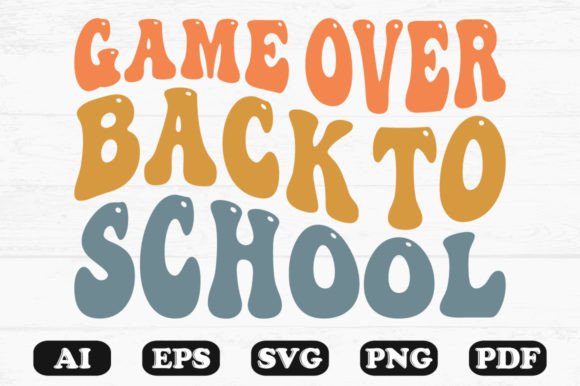
“Game over Back to School Sticker Design” isn’t just playful typography—it’s a purpose-built visual tool with tangible utility across branding, education, marketing, and small business operations. At its core, it’s a high-fidelity vector asset that communicates transition, reflection, and readiness—ideal for marking the end of summer, the close of a learning unit, or even the conclusion of a project cycle. Unlike generic clipart or low-res downloads, this design delivers professional-grade flexibility: scalable without distortion, editable in color and composition, and production-ready for print and digital applications alike.
Why This Design Fits Real-World Strategic Needs
For educators designing classroom materials, this sticker serves as more than decoration—it reinforces metacognition. Placed on student feedback forms or end-of-unit reflections, “Game over Back to School Sticker Design” visually cues closure and invites intentional review. For entrepreneurs launching back-to-school product lines, it adds tonal authenticity: witty yet respectful, nostalgic but forward-looking. Marketers use it to punctuate email campaigns, social posts, or limited-edition packaging—leveraging shared cultural rhythm without leaning into cliché.
The strategic value lies not in the phrase itself, but in how consistently and contextually it’s applied. A single well-placed “Game over Back to School Sticker Design” on a teacher’s welcome slide signals structure and clarity. On a vinyl decal for a tutoring center’s storefront, it subtly positions the business as both supportive and results-oriented. In each case, the design functions as a micro-branding decision—not filler, but framing.
Practical Use Cases That Deliver Measurable Outcomes
- T-shirt and apparel design: Schools, PTA groups, and edtech startups use it on staff shirts or student merch—building cohesion while reducing design time. Because the file includes SVG, EPS, and DXF formats, it cuts seamlessly into cutting machines for vinyl application or embroidery digitizing.
- Classroom and curriculum materials: Inserted into editable PDFs or Canva templates, it marks assessment checkpoints or final project submissions—supporting learner autonomy and timeline awareness.
- Small business signage and promotions: Cafés near campuses, stationery shops, or after-school programs apply it to window decals or loyalty cards, aligning seasonal messaging with local demand cycles—without needing custom illustration each August.
- Digital content and social media: The 300 DPI CMYK PNG ensures crisp rendering in email headers or Instagram story overlays. Paired with thoughtful copy (“Your summer break is officially game over—let’s level up”), it drives engagement rooted in timing and relevance.
How to Use It Intentionally—Not Just Conveniently
Using “Game over Back to School Sticker Design” effectively begins with asking: What outcome do I want this visual to support? If the goal is student motivation, pair it with actionable next steps—not just a graphic. If it’s brand consistency, embed it within an existing color palette and typographic system rather than treating it as a standalone novelty.
Consider timing. Launching it too early (mid-July) risks disconnect; too late (after Labor Day) misses momentum. The strongest deployments align with behavioral inflection points: the first faculty meeting, the week before orientation, or the day supply lists go live. That precision turns a decorative element into a functional cue.
Also weigh audience perception. For corporate training teams, “Game over Back to School Sticker Design” may resonate when reframed as “End of Onboarding Phase”—retaining the structure and tone while adapting to professional context. Flexibility isn’t just technical (SVG resizing); it’s semantic and situational.
What’s Inside the File Package—and Why Format Diversity Matters
You’ll receive a ZIP containing four production-ready files: SVG (for web and responsive scaling), PNG (high-res raster for presentations and social), EPS (industry-standard for Adobe Illustrator workflows), and DXF (for CNC, laser cutters, and sign-making software). All are 300 DPI, CMYK-mode, and fully layered—meaning you can isolate text, background, or icon elements independently.
This isn’t just convenience—it’s operational resilience. Need to adapt the sticker for a dark-themed newsletter? Adjust the CMYK values directly in Illustrator. Prepping for vinyl application on a fleet of school buses? Import the DXF into your cutter software without re-tracing. Building a series of themed stickers for a literacy program? Swap colors in seconds using the embedded swatches—no redrawing required.
And because every vector is hand-checked and optimized—not auto-traced—you avoid common pitfalls: stray anchor points, inconsistent stroke weights, or ungrouped layers that derail production. That quality control translates directly into time saved, fewer revision rounds, and fewer last-minute formatting fires.
Risks of Using It Without Strategic Alignment
A “Game over Back to School Sticker Design” dropped haphazardly into a flyer or slide carries little weight—and can even dilute credibility. When used without clear intent, it reads as decorative noise rather than deliberate communication. Worse, misaligned usage (e.g., applying it to a serious academic report or a sensitive parent notification) risks undermining tone and trust.
Another common misstep: treating scalability as permission to ignore context. Yes, the SVG resizes infinitely—but legibility at 12pt on a business card demands different spacing and weight than display at 48in on a banner. Blindly enlarging without checking kerning, line thickness, or contrast leads to fuzzy edges or unreadable details. Always test at intended size and medium before finalizing.
Finally, avoid assuming universality. While “back to school” resonates strongly in North America, international educators or bilingual programs may need localized phrasing or culturally attuned visuals. The design is adaptable—but adaptation requires intention, not assumption.
Long-Term Value Beyond the Season
Don’t limit “Game over Back to School Sticker Design” to August and September. Its underlying structure—clear hierarchy, balanced negative space, modular components—makes it a reusable foundation. Flip the color scheme and repurpose it as a “Project Complete” badge for client deliverables. Remove “Back to School” and retain the “Game Over” motif for gamified workplace training milestones. Combine it with other vector assets from your library to build custom monograms or branded worksheet headers.
That longevity pays dividends. One educator reported using the same base file across three academic years—updating only colors and minor text variants—freeing up 11+ hours annually on design tasks. A small business owner integrated it into her Canva Brand Kit, ensuring consistent visual language across 17 social templates and 5 printed collateral pieces. These aren’t hypothetical efficiencies—they’re documented outcomes of choosing assets built for reuse, not one-off consumption.
Making the Right Decision—Not Just the Fastest One
When evaluating creative resources, speed matters—but sustainability matters more. A free sticker downloaded from an unvetted site may save five minutes today but cost hours tomorrow in fixes, licensing questions, or rework. “Game over Back to School Sticker Design” offers verified quality, transparent format support, and professional-grade color fidelity—reducing downstream friction across teams, tools, and timelines.
Ask yourself: Does this asset integrate cleanly into my existing workflow? Can I modify it confidently—or will I need external help? Does it reflect the tone and standards my audience expects? If the answer to all three is yes, then it’s not just a sticker. It’s infrastructure.
Use it to mark transitions with clarity. Apply it where attention needs direction. Adapt it where consistency strengthens recognition. And always choose it—not because it’s available, but because it advances your objective.