Crab Clipart and Back to School Clipart: Practical Design Assets for Crafters and Educators
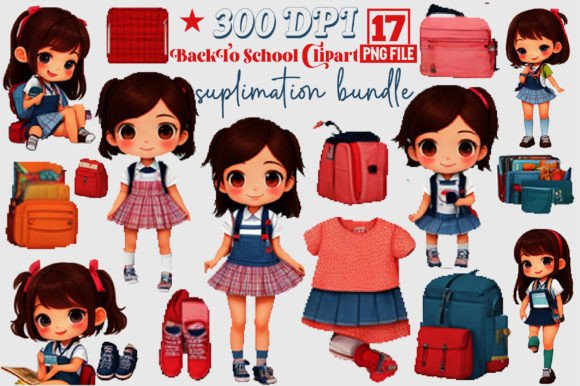
Crab clipart and back to school clipart represent two distinct yet overlapping categories of digital design assets—both widely used across creative, educational, and small-business contexts. What sets them apart isn’t just subject matter, but purpose, visual tone, and functional adaptability. Crab clipart tends toward playful, summery, or marine-themed applications—ideal for beach parties, ocean units, summer learning activities, or coastal branding. Back to school clipart, by contrast, centers on academic motifs: pencils, apples, notebooks, backpacks, and classroom scenes—designed to support the seasonal rhythm of education planning, teacher resources, and student engagement.
What unites these assets is their shared format and delivery: high-resolution PNG files with transparent backgrounds. This transparency eliminates white borders or background layers, allowing seamless integration into layered designs—whether you’re adding a crab icon over a custom invitation background, overlaying a chalkboard-style “first day” graphic onto a printable planner, or combining both styles in a themed bulletin board kit.
Why Format and Resolution Matter More Than You Might Think
The inclusion of 300 DPI resolution and PNG transparency isn’t a marketing flourish—it’s a functional requirement for many real-world uses. For printed stationery, scrapbooking elements, or sticker sheets, low-resolution JPEGs often pixelate when scaled or print with visible compression artifacts. A 72 DPI web image may look fine on screen but blurs at 2× or 3× print size. In contrast, 300 DPI ensures crisp lines and smooth edges even when enlarged for posters or reduced for die-cut stickers.
Transparency is equally consequential. Without it, designers must manually remove backgrounds using tools like Photoshop or Canva’s background remover—adding time, risk of uneven edges, and inconsistency across multiple files. With transparent-background PNGs, you can drag-and-drop an image directly into a layout and layer text or other graphics over it without clipping masks or extra steps. That efficiency compounds across projects: imagine designing 12 different classroom labels or 20 summer camp activity cards—each saving 60–90 seconds adds up to hours saved.
Color vs. Black and White: Flexibility Built In
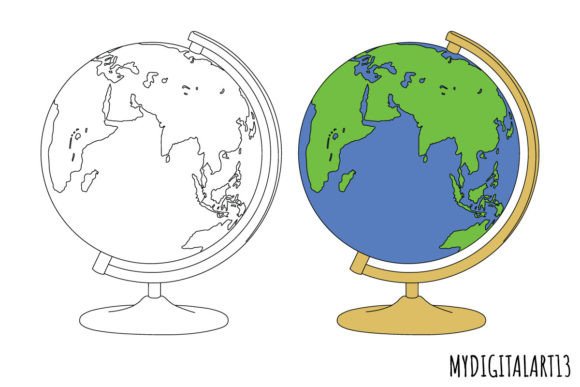
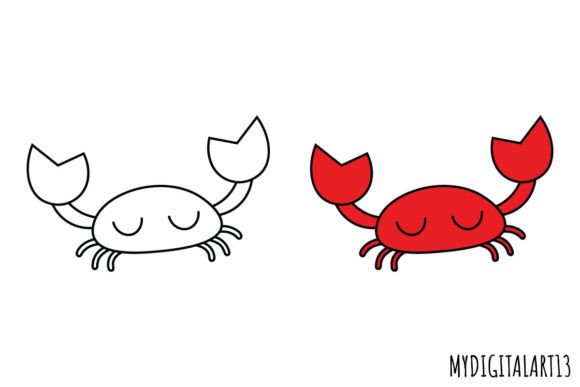
Each set includes both a full-color and a black-and-white version. This dual format supports divergent needs without requiring separate purchases or conversions. The color version works well for digital invitations, social media banners, or vibrant printables where mood and theme are central—think a cheerful crab waving beside “Welcome Back!” on a first-day-of-school poster. The black-and-white variant serves practical functions: coloring pages for students, stencil templates for vinyl cutting, embroidery guides, or monochrome handouts where ink conservation matters.
This pairing also simplifies accessibility and customization. Teachers adapting materials for students with visual processing differences may prefer line-art versions for clarity. Crafters using Cricut or Silhouette machines often need clean vector-like outlines—which high-contrast black-and-white PNGs provide, even if they’re raster-based. And because both versions share identical dimensions and alignment, swapping one for the other preserves layout integrity.
How These Clipart Sets Compare With Broader Design Options
When evaluating Crab clipart and back to school clipart against alternatives—such as subscription-based design libraries (e.g., Canva Pro, Creative Market bundles), free online repositories, or custom illustration commissions—the tradeoffs center on control, consistency, and long-term usability.
- Subscription libraries offer breadth but limit ownership: access ends when the subscription lapses, and licensing terms may restrict commercial use or resale of derivative products. With standalone clipart sets, you retain perpetual usage rights under standard commercial licenses—no recurring fees or platform lock-in.
- Free clipart sources often lack transparency, use inconsistent DPI, or embed watermarks. Some require attribution—even on internal classroom handouts—which adds friction. Professionally prepared Crab clipart and back to school clipart avoids those constraints while maintaining clean, classroom-safe aesthetics.
- Custom illustrations deliver uniqueness and brand alignment but demand time, budget, and clear briefs. For educators building weekly newsletters or parents organizing summer activity logs, ready-made, on-brand clipart offers immediacy without compromising quality.
Realistic Use Cases Across Contexts
These assets aren’t limited to obvious applications. Consider how a single crab icon might serve multiple purposes:
- A homeschool parent uses the black-and-white crab as a tracing guide for fine motor practice, then layers the color version onto a summer reading log header.
- A small stationery business incorporates the crab into a “Summer Splash” sticker sheet, then repurposes the same file—scaled and recolored—as part of a back-to-school welcome kit for coastal charter schools.
- An elementary art teacher prints the black-and-white version on cardstock for a cut-and-collage ocean unit, then projects the color version during a digital storytelling lesson.
Similarly, back to school clipart extends beyond August calendars. Its motifs work year-round: pencil icons label homework folders in February; apple graphics anchor gratitude journal prompts in November; notebook patterns become subtle backgrounds for report card comment templates in June.
When This Clipart May Not Be the Best Fit
While versatile, these assets have natural boundaries. They’re not substitutes for editable vector files (like SVG or AI) if you need to infinitely scale without quality loss or adjust individual anchor points. Nor do they replace photography or realistic illustrations when authenticity is essential—say, depicting diverse student experiences or accurate classroom technology.
They also assume a moderate level of design familiarity. Users who rely entirely on template-driven tools (e.g., basic Word mail merge or elementary-grade drag-and-drop apps) may find little advantage over built-in shapes or icons—unless they’re assembling multi-element printables where consistent style and resolution matter.
If your work demands photorealism, dynamic animation, or interactive elements (e.g., hover effects on a school website), static PNGs won’t meet that need. Likewise, if licensing requires attribution-free redistribution within open-source curricula or government education portals, verify the specific license terms before large-scale deployment.
Making a Purposeful Choice
Selecting Crab clipart or back to school clipart isn’t about finding the “best” clipart—it’s about matching format, fidelity, and flexibility to your actual workflow. Ask yourself:
- Do I regularly produce printed or layered digital materials where clean edges and scalability affect professionalism?
- Am I balancing time efficiency with visual cohesion—especially across multiple related projects?
- Do I need both expressive (color) and functional (black-and-white) variants without conversion overhead?
- Is perpetual, license-clear usage more valuable than temporary access to broader—but less curated—libraries?
For educators preparing classroom kits, small-business owners designing seasonal product lines, or hobbyists building personalized paper goods, Crab clipart and back to school clipart offer a pragmatic middle ground: higher fidelity than generic free assets, greater immediacy than custom work, and broader applicability than narrowly themed alternatives.
Ultimately, their value emerges not in isolation—but in how consistently they support real tasks: reinforcing themes across a summer camp series, unifying a school-year resource bundle, or simply helping someone finish a meaningful craft project without wrestling with file formats.